Big Data
MinIO AIStor and FlashBlade in the Enterprise S3 World
Comparing MinIO AIStor and Pure Storage FlashBlade in terms of performance, scalability, operations, security and total cost.
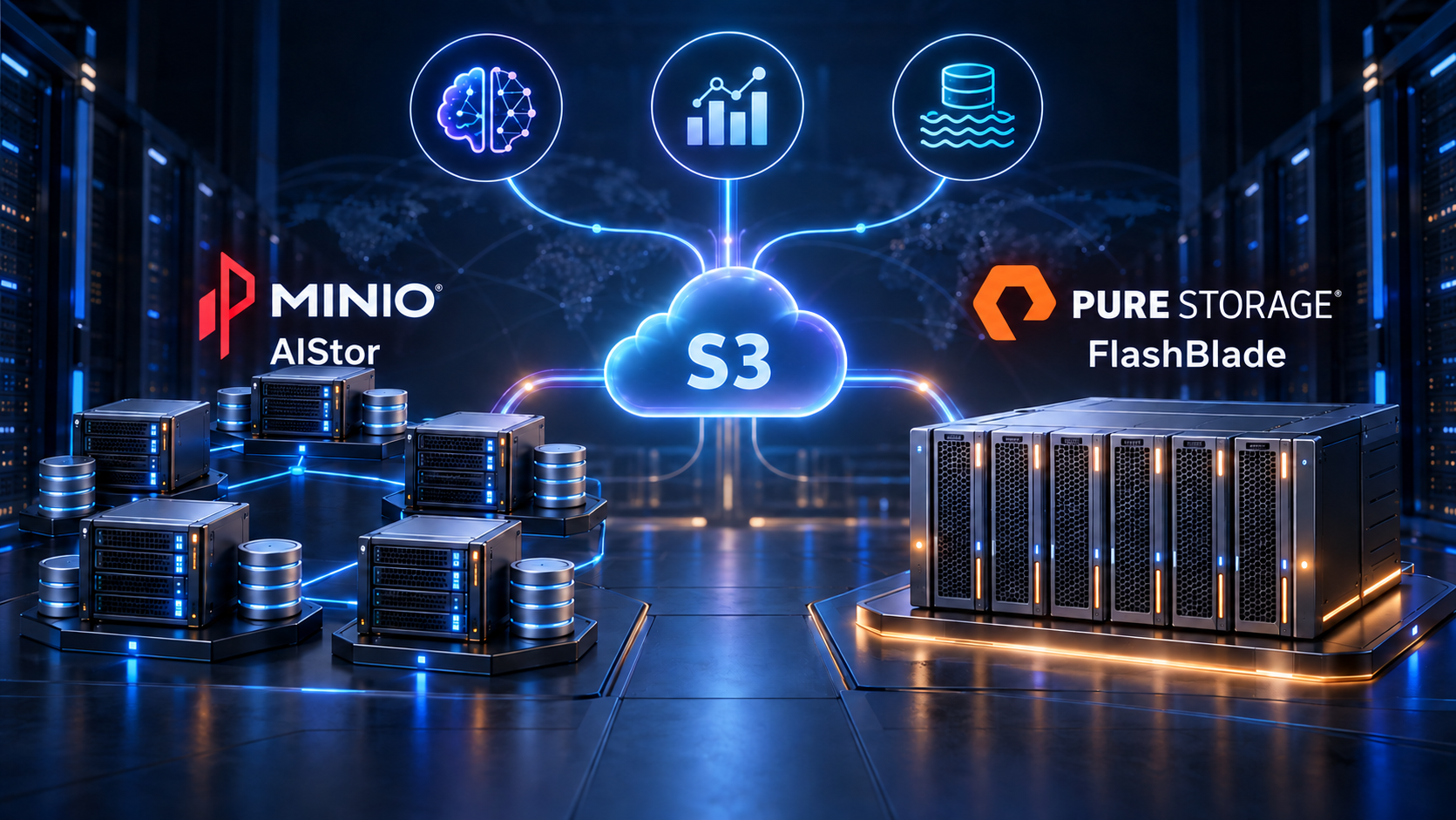
The role of the storage layer in enterprise data architectures is changing quickly. Storage used to be a passive infrastructure component sitting behind applications. Today it sits at the centre of the platform for data lakes, real-time analytics systems, AI models and Kubernetes applications.
The common language of this transformation has largely become the S3 API.
When people hear “S3” they often still think of a public cloud service first. But S3 has also become a widely adopted API standard that lets applications talk to object storage systems. Solutions such as MinIO AIStor and FlashBlade allow organisations to build S3-based data platforms in their own data centres or in hybrid architectures.
That said, being “S3 compatible” does not mean every product shares the same architecture, performance profile or operating model.
S3 Is an Access Layer, Not a Product
When evaluating an enterprise S3 platform, it is not enough to confirm that a bucket can be created and an object can be written. The API operations the application uses, the number of concurrent connections, object sizes, metadata intensity and failure scenarios must all be assessed.
For example, the storage behaviour of the following workloads differs significantly:
- Analytical queries reading large Parquet files
- Applications creating millions of small objects
- Lakehouse tables running on Apache Iceberg
- AI training data sets and model checkpoint files
- Backup and long-term archive data
- Analytical databases processing real-time data
- Stateful applications running on Kubernetes
The right question is therefore not only “Does it support S3?”. The real question is: “At what performance, durability and operational cost will this S3 implementation serve our actual workload?”
What Is MinIO AIStor?
MinIO AIStor is a software-defined enterprise data platform built around S3-compatible object storage. The current AIStor architecture offers the S3 API for objects, native Apache Iceberg support for tables, and SFTP for file-based access needs.
A software-defined approach lets the organisation choose its servers, disks, network and deployment model according to its own standards. AIStor can be deployed on Linux servers, container environments, Kubernetes and OpenShift.
The core capabilities stated in vendor documentation are:
- Flexibility in hardware selection
- A distributed architecture that grows horizontally
- Close integration with Kubernetes and the cloud-native ecosystem
- Integration with existing S3-based applications
- Apache Iceberg based lakehouse scenarios
- Replication, encryption, immutability and lifecycle management
- Edge, central data centre and hybrid deployment options
However, flexibility also brings more architectural responsibility. Server standards, disk layout, network capacity, failure domain design, load balancing, the operating system and capacity growth must all be planned correctly by the organisation.
Seeing AIStor as merely software that can be installed is incomplete. In production it is a distributed data platform that must be treated together with hardware, network and an operating model.
What Is FlashBlade?
FlashBlade is a scale-out, all-flash file and object storage platform developed by Pure Storage. It can offer native NFS, SMB and S3 services on the same system.
Unlike AIStor, FlashBlade is an integrated system in which the hardware and the storage software are designed together by the vendor. Instead of the organisation assembling individual servers, disks and storage software, it provides a more unified infrastructure.
Capabilities highlighted by the vendor include:
- Native S3, NFS and SMB services
- All-flash storage architecture
- Scale-out capacity and performance
- A central and simple operating model
- A non-disruptive upgrade approach
- Immutable snapshots and SafeMode features
- Focus on analytics, AI and rapid backup workloads
- Unified vendor support for hardware and software
This model can be a strong option for organisations that do not want to design storage infrastructure themselves or that prioritise operational simplicity. In return it offers less flexibility in hardware choice and physical architecture than software-defined systems.
Are AIStor and FlashBlade in the Same Category?
Not exactly. Both solutions can provide S3 access to applications, but they do so at different layers.
| Topic | MinIO AIStor | FlashBlade |
|---|---|---|
| Platform model | Software-defined data platform | Integrated hardware and software platform |
| Main access methods | S3, Iceberg and SFTP | S3, NFS and SMB |
| Hardware selection | Chosen by the organisation or partner | Platform supplied by the vendor |
| Scaling | Horizontal growth with new servers and disks | Scale-out within the FlashBlade platform |
| Operational responsibility | A large part of the infrastructure sits with the organisation | More unified vendor-side operations |
| Key advantage | Flexibility and a cloud-native approach | Predictable performance and operational simplicity |
| Suitable scenarios | Data lake, lakehouse, AI and Kubernetes | AI, analytics, rapid backup and unified file/object storage |
This distinction matters during procurement. On one side software licences, servers, disks, network and an operations team are evaluated together; on the other side the total lifecycle cost of an integrated storage platform is evaluated.
Does Placing MinIO in Front of FlashBlade Make Sense?
Technically it can be possible to position different products within the same architecture. But because FlashBlade already provides a native S3 service, adding another S3 layer in front of it does not automatically create a better architecture.
The following assessment is an architectural observation, not a vendor benchmark. Such a design may:
- Add extra network hops
- Widen the failure domain
- Make observability harder
- Split support responsibility between two vendors
- Complicate troubleshooting
It is therefore more accurate to evaluate MinIO AIStor and FlashBlade as two different S3 platform approaches rather than as two layers that necessarily stack on top of each other.
If they are used together, that decision should be based on a specific need — for example different data centres, different performance classes, backup, data copying or separate security zones. In those scenarios API compatibility, the replication method and the vendor support matrix must be validated during the PoC.
Gold, Silver and Bronze S3 Tiers
Storing all data at the same performance level is inefficient both technically and economically. An enterprise object storage architecture can be split into service classes.
Gold Tier
The gold tier can serve workloads that require low latency and high throughput:
- Active analytical data sets
- AI training data
- Model and checkpoint files
- Frequently queried Iceberg tables
- Real-time data platforms
- Fast-restore copies of critical backups
In this tier, network capacity, parallel request performance and metadata operations matter at least as much as raw storage capacity.
Silver Tier
The silver tier can be positioned for general purpose enterprise data:
- Historical data queried at moderate frequency
- Reporting data sets
- Files shared between business units
- Less active lakehouse tables
- Application logs and operational data
This tier seeks a balance between performance and capacity cost.
Bronze Tier
The bronze tier can be used for data accessed less frequently:
- Long-term archive
- Data retained for regulatory reasons
- Older backups
- Rarely queried historical data sets
- Disaster recovery copies
In the bronze tier, not only cost per TB but also retrieval time, minimum retention period, immutability and recovery procedures must be considered.
How Should an Enterprise PoC Be Run?
Maximum throughput figures published by a vendor are not sufficient on their own for a purchasing decision. PoC tests must use the organisation's real data profile.
1. Object profile
Average and maximum object sizes must be determined. A workload made of a few large files does not produce the same result as one made of millions of small objects.
2. API operations
The distribution of GET, PUT, LIST, DELETE and multipart uploads must be measured. LIST and small-object operations in particular can create a different load on the metadata layer.
3. Concurrency
Single-client throughput testing is not enough. The connections and requests generated simultaneously by Spark, Trino, databases and AI clients must be simulated.
4. Network architecture
The choice between 25, 40, 100 or 200 GbE should not be based on storage capacity alone. The whole network path from clients to the storage system must be reviewed.
5. Failure testing
Disk, node, network interface, switch and data centre loss scenarios must be tested. It must also be measured how much performance degrades while the system keeps running during a failure.
6. RPO and RTO
The presence of a replication feature is not sufficient by itself. How much data loss is acceptable for which data, and how quickly the service must be restored, has to be defined in advance.
7. Security
The following capabilities must be validated against the organisation's security standards:
- TLS
- At-rest encryption
- External key management system
- IAM and role-based access control
- LDAP or enterprise identity integration
- Object Lock and immutability
- Audit logging
- Key and certificate rotation processes
8. Operations and support
Upgrades, capacity expansion, disk replacement, node addition and disaster recovery must be included in the PoC scope. A successful storage platform is not only fast in normal times but also manageable during failures and changes.
How Should Total Cost Be Calculated?
Cost comparison of S3 platforms must not be made only on price per usable TB. Total cost of ownership should include:
- Software licence and subscription
- Server and storage hardware
- Network infrastructure
- Rack space, power and cooling
- Secondary data centre capacity
- Operations and support staff
- Version upgrades
- Hardware refresh cycles
- Data migration
- The business cost of planned and unplanned downtime
A software-defined solution may look advantageous in initial investment but can require more in-house operations. An integrated platform may have a higher purchase price yet provide advantages in management, support and refresh processes.
A correct comparison should not stop at CapEx; it should cover at least a three to five year total lifecycle.
When Should Each Approach Be Preferred?
MinIO AIStor is a strong candidate when:
- The organisation has a strong Linux, Kubernetes and platform operations team
- Control over hardware selection is desired
- A cloud-native, software-defined architecture is a priority
- An Apache Iceberg based lakehouse is targeted alongside S3
- A standard data layer is needed across different locations and infrastructures
FlashBlade may stand out when:
- Predictable high performance is important
- An all-flash platform is targeted
- NFS and SMB are needed alongside S3
- Operational simplicity is a priority
- Single-vendor responsibility for hardware and software is preferred
- Rapid backup, recovery, analytics and AI workloads will be consolidated on one platform
Conclusion
There is no single winner in a MinIO AIStor versus FlashBlade comparison, because these products solve the same problem with different operating and ownership models.
AIStor offers more flexibility, a software-defined architecture and cloud-native integration. FlashBlade provides an all-flash, more unified operating model where hardware and software are designed together.
An enterprise decision should start with four questions:
- What is the real access profile of the data to be stored?
- Is the expected performance only about throughput, or are metadata and small-object performance also critical?
- How much of the infrastructure does the organisation want to operate itself?
- What are the failure, replication and recovery targets?
S3 compatibility is the starting point of the decision process, not the end. The right platform is not the one with the longest feature list, but the one that can sustainably run the organisation's real workload within the defined RPO, RTO, security and cost boundaries.
Note: Product capabilities in this article are based on vendor documentation; performance commentary is architectural assessment, not an independent benchmark result.
References
Related topics
You may also like

Data Engineering Principles: Building Reliable Systems, Not Just Pipelines
Practical data engineering principles for designing reliable, scalable, observable and maintainable data platforms - from Kafka and CDC to data lakes and real-time analytics.
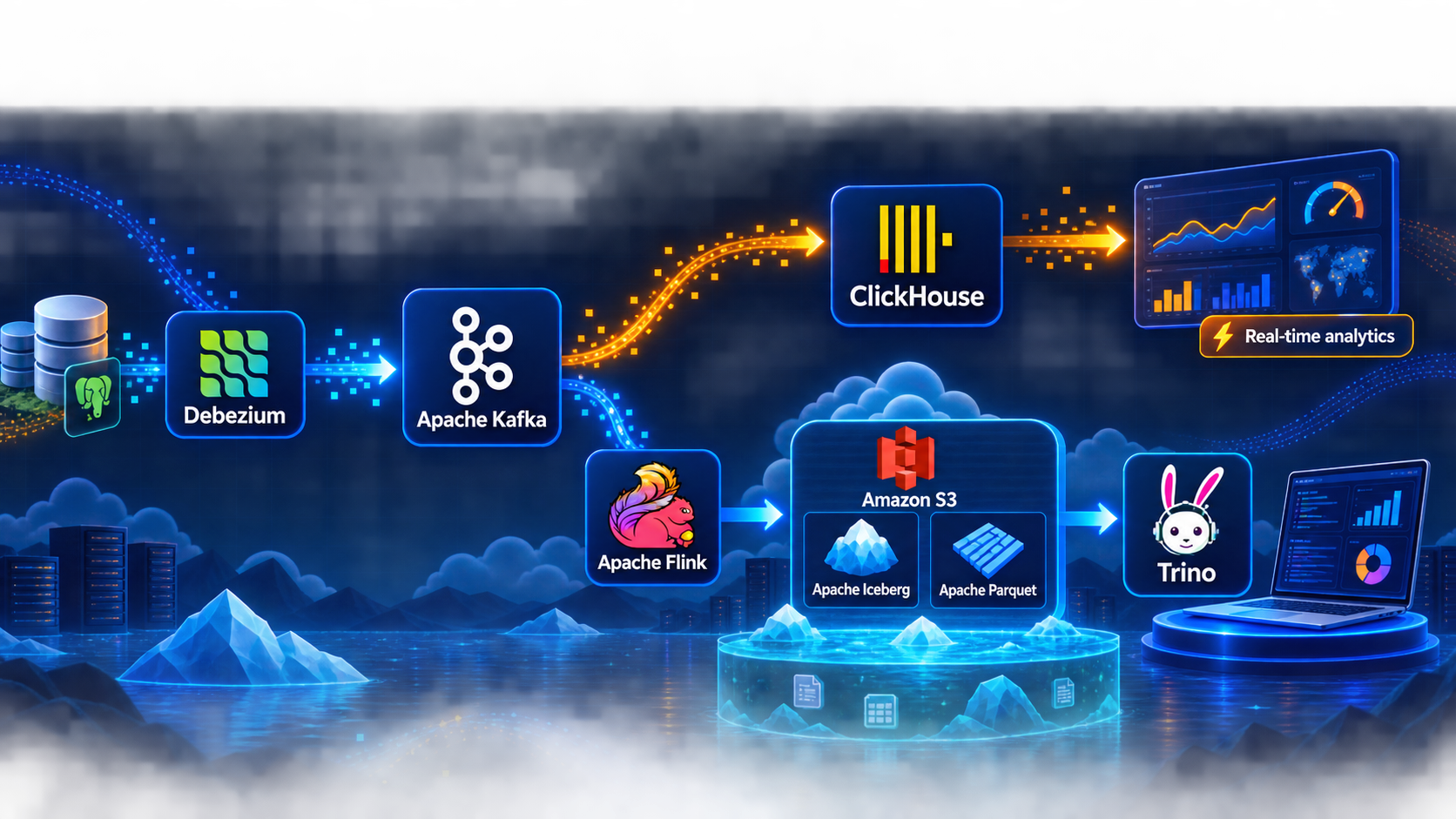
Building a Real-Time Lakehouse with Kafka, ClickHouse, Trino and Iceberg
Learn how Kafka, ClickHouse, Trino, S3, Parquet and Apache Iceberg work together to support real-time analytics, historical data and SCD tables.
SingleStore 9 vs. Previous Versions: A Practical Guide to the Real-Time, Hybrid Database
SingleStore 9 continues the evolution from a fast HTAP database into a broader real-time data platform for operational applications, analytics, search, and AI.