Artificial Intelligence & Technology
Will Google Lose Power as LLMs Become Advertising Platforms?
The next battle may not be about who owns search. It may be about who owns user intent, decisions, and actions.
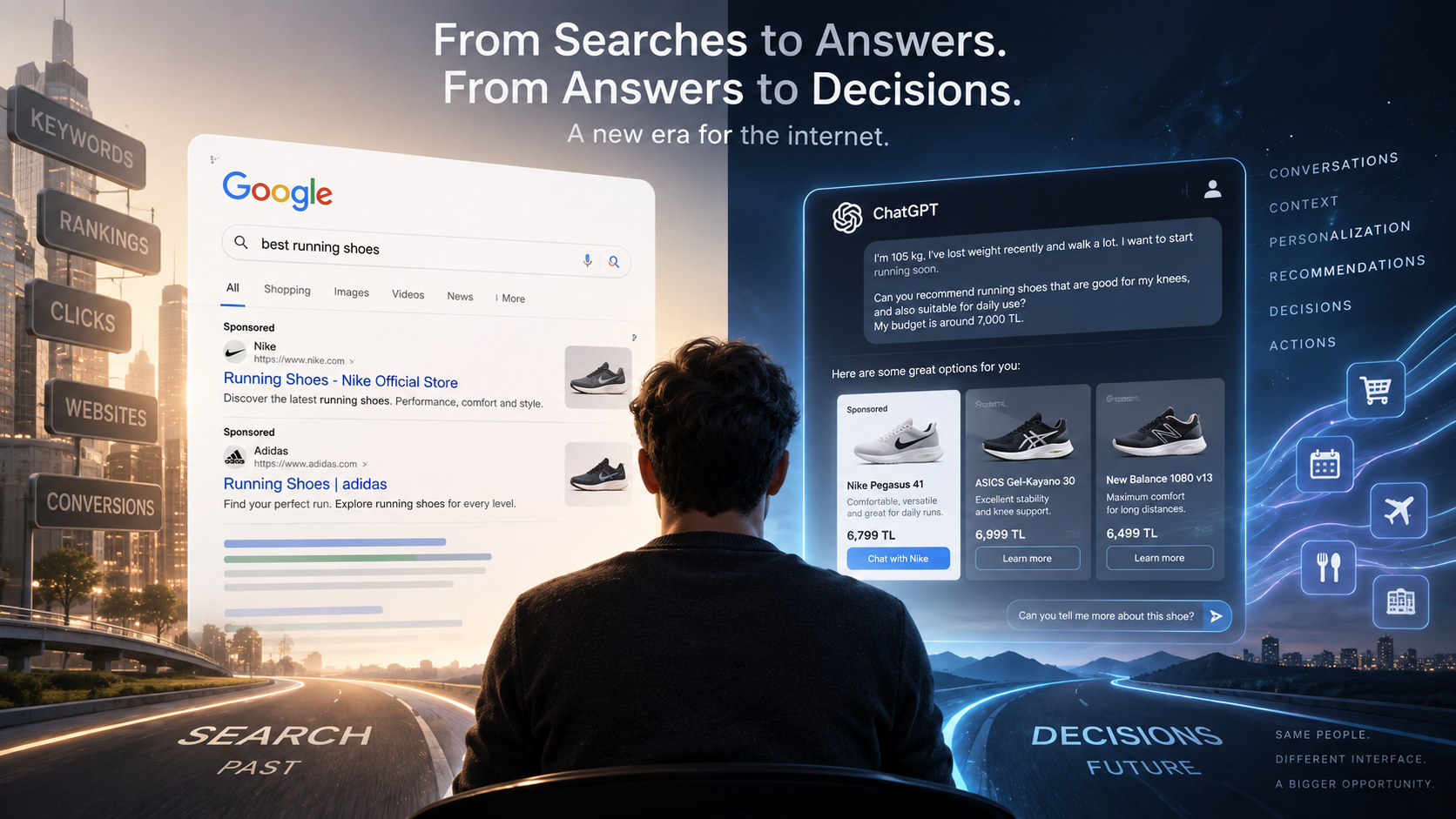
A few days ago, I received an email from ChatGPT about sponsored content.
At first, this may sound like a predictable development. If hundreds of millions of people use an AI product, advertising will eventually become part of the business model.
But I think something much bigger is happening.
LLMs are not simply adding banners to chat interfaces. They are moving toward becoming advertising, recommendation, decision and, eventually, transaction platforms.
OpenAI’s 16 September 2026 announcement makes that direction unusually concrete. The company is testing Sponsored Agents with selected US advertisers: after clicking a clearly labelled ad, a user can continue in a conversation with a business-sponsored AI agent.
That could challenge one of the most powerful business models the internet has ever seen: Google’s ability to capture user intent.
My central argument is not that people will abandon Google.com overnight. The real risk is that the high-intent moments immediately before a purchase or decision move into LLM interfaces.
Google’s Real Power Was Never Just Search
Google did not become one of the most valuable companies in the world simply because it created a great search engine. Its real advantage was understanding what people wanted at exactly the right moment.
When somebody searched best hotel in Rome, they were probably planning a trip. When somebody searched MacBook Pro price, they were probably considering a purchase. When somebody searched mortgage rates, they were approaching a financial decision.
These queries were extremely valuable because they revealed intent.
Facebook could understand who you were. Instagram could understand what you liked. TikTok could understand what kept your attention. But Google understood something even more valuable: What do you want right now?
Google Ads was built around that advantage.
Search Queries Are Becoming Conversations
LLMs change this dynamic. Traditional search queries are short. For example:
best running shoesBut a user might tell an AI assistant:
I recently lost weight, I walk around 80,000 steps per week, and I want to start running soon. I need something that will protect my knees but also work for daily walking. My budget is around $200.
From an advertising perspective, these two interactions contain completely different levels of information. The first gives the system a keyword. The second provides intent, budget, usage pattern, constraints, preferences, stage of decision and likely objections.
This creates something potentially more valuable than search keywords: intent density.
LLMs can understand why the user wants something, not only what they searched for.
Advertising No Longer Has to Be a Link
Google’s traditional advertising funnel looks roughly like this:
Search → Ad → Click → Website → ConversionThe user searches, sees an ad, visits the company’s website, researches the product, answers their remaining questions and eventually buys.
An AI-native advertising funnel could look very different:
Conversation → Recommendation → Sponsored Agent → Decision → TransactionImagine asking an AI assistant to find a hotel. It recommends three properties. One result is sponsored. But instead of sending you to another website, clicking it opens a conversation with the hotel’s AI agent.
You ask whether the room has a desk, whether airport transfer is available, whether you can check in after midnight and how much the sea-view upgrade costs. The agent answers everything. Then you say: “Book it.”
That is where the real threat to traditional search begins.
From Search Engine to Decision Engine
The original internet was largely about finding information. Google solved this problem incredibly well: you asked a question and Google found the right webpage.
But users increasingly do not want webpages. They want answers, recommendations, decisions and actions.
“Which of these two laptops is better for me?” “Find a restaurant for four people in Istanbul on Friday evening.” “Choose a hotel for my trip.” “Which jobs should I apply for based on my CV?” “Compare these three insurance offers.”
These users are not really searching for websites. They are trying to make decisions. This is why calling LLMs simply “new search engines” misses the bigger shift. They may become decision engines.
The Zero-Click Internet Is Already Here
This change is already visible inside Google. AI-generated summaries increasingly answer questions directly on the results page, so the user may never need to visit the original website.
A Pew Research Center study published in July 2025, based on browsing data collected from 900 US adults in March 2025, found that users clicked a traditional result in 8% of searches that showed an AI summary, compared with 15% when no AI summary appeared. Clicking a source inside the AI summary was rarer still: 1%.
These are not 2026 figures, and one study should not be treated as a complete map of global behaviour. But the direction matters: when the interface provides the answer, users often do not continue to the open web.
This affects more than Google. It changes the economics of SEO, affiliate marketing, comparison sites, publishers, review platforms and many SaaS acquisition strategies.
From SEO to GEO
For the last twenty years, companies asked: “How do I rank first on Google?” In the next few years, they may increasingly ask: “When does ChatGPT, Gemini, Claude or another AI assistant recommend my product?”
That is a different problem. In the Google era, companies optimized websites for crawlers and search rankings. In the AI era, they may optimize to become understandable, trustworthy, citable, comparable and recommendable.
This is why concepts such as GEO — Generative Engine Optimization and AEO — Answer Engine Optimization are becoming increasingly important. The future may not be about ranking first among ten blue links. It may be about appearing inside the answer itself.
Where Is the Real Risk for Google?
I do not think Google is disappearing. The opposite is true.
According to Statcounter’s worldwide measurement, Google still held roughly 91.1% of conventional search-engine usage in August 2026. This measures search-engine market share, not the share of commercial decisions across every interface, so the distinction matters.
Alphabet’s own Q2 2026 earnings release reported that Google Search & other revenue grew 17% year over year. The existing business remains exceptionally strong.
Google also has Android, Chrome, Maps, YouTube, Gmail, Shopping, Google Ads and, most importantly, Gemini. It is already integrating AI into search and advertising. In 2026 Google expanded ads in AI Mode and continued testing Direct Offers for high-intent shopping moments.
These are Google’s own product announcements, not independent evidence that the new formats will succeed. Still, they show that Google understands the transition.
So the future is unlikely to be “Google versus AI.” Google itself is one of the largest AI companies in the world. The real competition is: Who owns the interface where users make decisions?
Search Market Share May Become the Wrong Metric
People often measure Google’s position using search-engine market share. But another metric may become more important: Commercial Intent Share.
What percentage of moments when people research products, plan travel, choose software, compare insurance, look for restaurants, search for jobs, buy cars or make major financial decisions begin inside Google?
If even part of those behaviours move to AI assistants, Google’s traditional search share could remain extremely high while some of its economic power shifts elsewhere. Not every query has equal value. The most valuable queries are the ones closest to a decision.
This Is Becoming an Assistant Market, Not a Two-Company Race
The change is not simply “ChatGPT versus Google.” According to Similarweb’s 2026 Generative AI Landscape, ChatGPT’s share of generative-AI web traffic fell from roughly 76% a year earlier to around 53%, while Gemini rose above 25%.
Similarweb’s figures are panel-based estimates, not a census of all AI use. Yet they point to a broader transition: users may be moving from a search-engine market into a more fragmented AI-assistant market.
The Rise of AI-Native Advertising
OpenAI says ChatGPT Ads reached a $1 billion annualized revenue run rate by 31 August 2026, less than 200 days after launch, while ChatGPT was serving more than one billion weekly active users.
Those are OpenAI’s own disclosed figures. “Annualized run rate” is an extrapolation of the current revenue pace, not $1 billion of revenue already booked over the previous twelve months. That distinction is important.
Combined with Sponsored Agents, however, the direction is clear. OpenAI may not merely be putting ads inside ChatGPT. It may be trying to build an AI-native advertising platform.
Google Ads was built around the keyword. Meta Ads was built around the social graph. TikTok Ads was built around the interest graph. LLM advertising could be built around something richer: the conversation graph.
The system may understand why a user asked, which options they are comparing, what their constraints are, what objections remain and what would make them decide.
Trust Will Be the Critical Currency
The greatest advantage of AI advertising also creates its biggest risk. Users ask AI assistants for recommendations because they expect useful and relatively neutral guidance.
If a user asks for the best three hotels, they need to understand whether a recommendation appears because it is genuinely relevant or because an advertiser paid for placement. If that boundary becomes unclear, trust can disappear quickly.
Sponsored recommendations therefore need to be unmistakably labelled. The distinction between recommendation and advertisement must remain clear.
In the AI advertising era, the most important metric may not be CPC or CTR. It may be trust.
The Advertisement of the Future May Be an AI Agent
In the 1990s, an ad was a banner. In the 2000s, Google turned advertising into a link. In the 2010s, social media turned it into content. Later, influencers became advertising channels themselves.
Now advertising may become an AI agent you can talk to. It can explain the product, answer questions, compare alternatives, personalize an offer, handle objections and eventually complete the transaction.
Advertising metrics may therefore change too. Instead of only measuring impressions, clicks and CTR, we may measure conversations started, questions answered, recommendations accepted, agent-assisted conversions and completed actions.
Google Is Not Dying, but Its Gateway Role Could Weaken
The question “Will ChatGPT kill Google?” is too simplistic. Google will likely remain one of the most important companies on the internet for many years.
But for the last two decades, much of the internet economy was built around one habit:
I want something → I search Google.The next habit may become:
I want something → I tell my AI assistant.That sounds like a small interface change. It is not. When users stop searching and start talking to an AI, they are not simply changing search engines. They are changing the interface where they make decisions.
Google’s biggest risk may therefore not be losing search market share. It may be losing its position as the default owner of internet intent.
Search → Answer → Decision → Action
Google dominated the first stage. It is aggressively competing in the second. But the winners of the third and fourth stages are not yet obvious.
When people want to make a decision, where will they go first? Google? ChatGPT? Gemini? Claude? Or a personal AI agent that does not exist yet?
The answer will shape more than the future of search. It may shape the future of digital advertising itself.
The next battle of the internet may not be about who owns search. It may be about who owns intent.
Related topics
You may also like
Science & Technology
How Do You Communicate When You Share No Language?
Coming soon
Science & Technology
How AI Agents Could Change the Internet
Coming soon
Science & Technology
From SEO to GEO: How Brands Will Compete in AI Answers
Coming soon