Artificial Intelligence & Technology
Beyond Prompt Engineering: Frontier AI, Agentic AI and Loop Engineering
From single prompts to autonomous, self-improving AI systems that build real products.
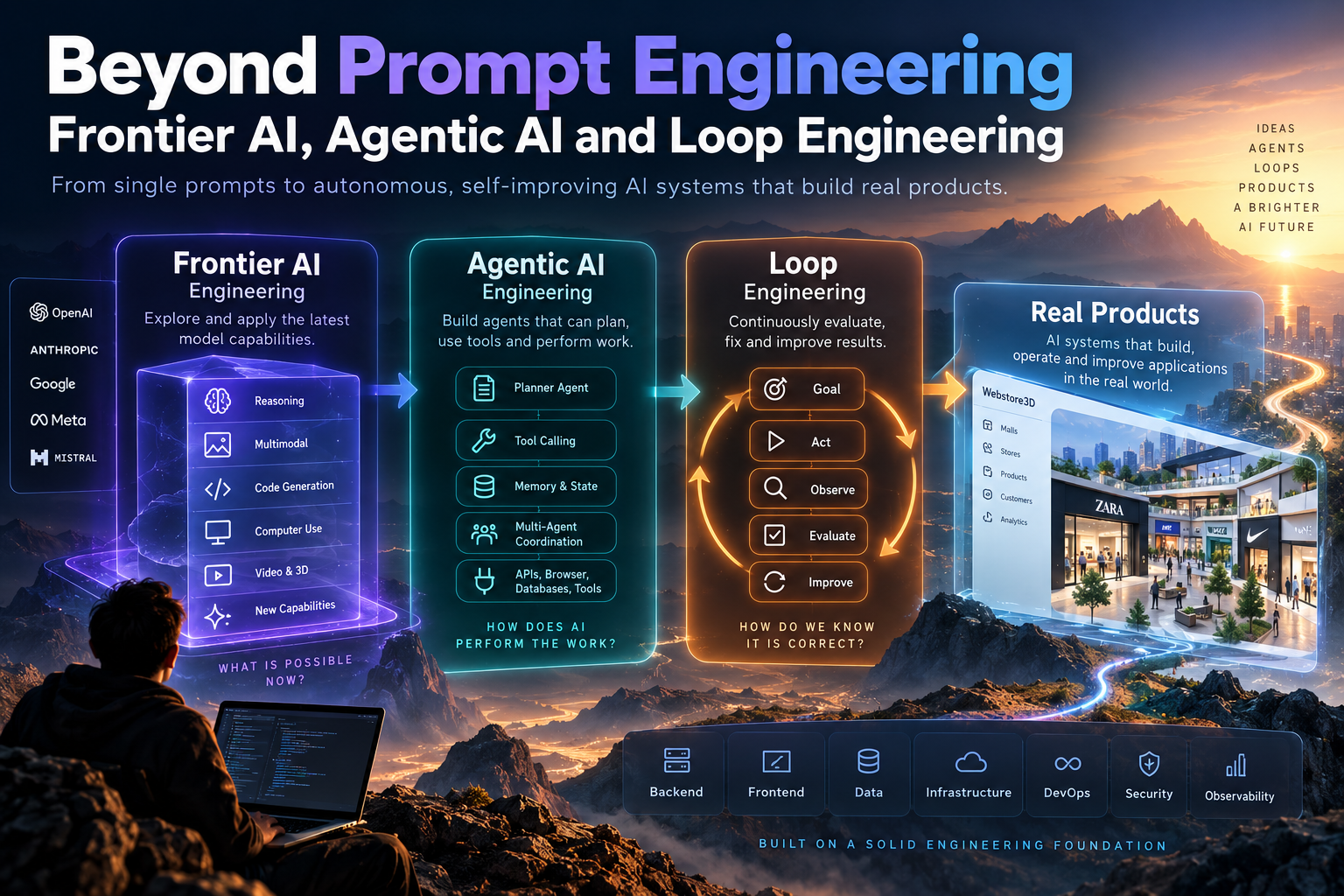
For the last few years, much of AI application development has revolved around one concept: prompt engineering.
We learned how to give large language models better instructions, provide better context, structure outputs, and connect models to APIs.
But the way we build software with AI is starting to change.
The next generation of AI applications will not be built around a single prompt and a single response.
They will be built around systems that can plan, act, observe, evaluate, correct themselves, and continue working toward a goal.
This shift is creating several emerging engineering disciplines:
- Frontier AI Engineering
- Agentic AI Engineering
- Loop Engineering
These areas overlap, but they solve different parts of the problem.
Together, they may form the foundation of the next generation of software engineering.
From Prompt Engineering to AI Systems Engineering
A traditional LLM application often looks like this:
User
 ↓
Prompt
 ↓
LLM
 ↓
Response
This architecture works well for many applications.
But it has a fundamental limitation.
The model gets one opportunity to generate an answer.
If the result is wrong, incomplete, or broken, the user usually becomes the feedback mechanism.
The process becomes:
User asks
 ↓
AI generates
 ↓
Something is wrong
 ↓
User explains the problem
 ↓
AI tries again
In other words, the human is the loop.
Modern AI systems are starting to move that responsibility into the software itself.
Instead of generating once, the system can repeatedly:
Understand
 ↓
Plan
 ↓
Act
 ↓
Observe
 ↓
Evaluate
 ↓
Improve
 ↓
Repeat
This is where Frontier AI Engineering, Agentic AI Engineering and Loop Engineering become important.
1. Frontier AI Engineering
Frontier AI Engineering is about understanding and applying the capabilities of the most advanced AI models.
The goal is not simply to integrate an LLM API.
The important question is:
What can today's models do that was technically impractical six months ago?
Frontier models are evolving rapidly.
Capabilities increasingly include:
- advanced reasoning
- multimodal understanding
- image generation
- video understanding and generation
- large-context processing
- computer use
- browser interaction
- code generation
- tool use
- autonomous planning
A Frontier AI Engineer explores these capabilities and determines how they can create real product value.
The workflow might look like:
New AI capability
        ↓
Capability evaluation
        ↓
Prototype
        ↓
Benchmark
        ↓
Cost / latency / quality analysis
        ↓
Product integration
The role sits somewhere between research engineering and product engineering.
A Frontier AI Engineer should continuously ask:
What has recently become possible?
And more importantly:
Does this new capability change how we should build our product?
Frontier AI Is More Than Model Selection
Choosing between different models is only one part of the job.
The larger responsibility is understanding what new interaction models become possible.
For example, traditional applications are built around predefined interfaces.
Button
Form
Menu
Dashboard
API
Frontier AI introduces a different possibility.
The interface itself can become dynamic.
A user might simply describe an objective:
"Analyze today's market activity,
identify unusual behavior,
compare it with historical conditions,
and prepare a summary."
Instead of navigating multiple dashboards, the AI system could determine how to perform the task.
The software begins moving from:
Applications with AI features
toward:
AI systems capable of operating applications.
2. Agentic AI Engineering
Frontier models provide intelligence.
But intelligence alone does not create autonomous systems.
That is the role of Agentic AI Engineering.
Agentic AI Engineering focuses on creating AI systems that can perform work instead of simply generating responses.
An agent typically has several capabilities:
Goal
 ↓
Reasoning
 ↓
Planning
 ↓
Tool selection
 ↓
Action
 ↓
Observation
 ↓
State update
 ↓
Next action
The agent may interact with:
- databases
- APIs
- browsers
- internal services
- file systems
- search engines
- development tools
- cloud infrastructure
- enterprise applications
This turns the LLM from a conversational interface into an execution engine.
From AI Assistant to AI Worker
Consider a normal coding assistant.
You ask:
Create a new product page.
The AI generates code.
But an agentic development system could do much more.
It could:
Read the requirement
        ↓
Inspect the repository
        ↓
Understand existing architecture
        ↓
Create an implementation plan
        ↓
Modify the frontend
        ↓
Modify the backend
        ↓
Update database models
        ↓
Run tests
        ↓
Run the application
        ↓
Inspect errors
        ↓
Fix them
        ↓
Create a pull request
Now we are no longer talking about code generation.
We are talking about delegating engineering work.
That distinction is important.
What Does an Agentic AI Engineer Build?
Agentic AI Engineers work on infrastructure such as:
- agent orchestration
- tool calling
- Model Context Protocol integrations
- state management
- memory
- planning
- multi-agent systems
- workflow engines
- permissions
- retry mechanisms
- task queues
- human approval mechanisms
- observability
- guardrails
A typical architecture could look like:
                 USER GOAL
                     │
                     ▼
                ORCHESTRATOR
                     │
        ┌────────────┼────────────┐
        ▼            ▼            ▼
    Research       Coding       Data
     Agent          Agent       Agent
        │            │            │
        └────────────┼────────────┘
                     ▼
                  TOOLS
                     │
         ┌───────────┼───────────┐
         ▼           ▼           ▼
      Browser       APIs       Database
The challenge is not simply making an agent intelligent.
The challenge is making it reliable.
And that leads to the next discipline.
3. Loop Engineering
Loop Engineering focuses on how AI systems continuously evaluate and improve their own work.
This may become one of the most important engineering concepts in agentic software.
A simple AI application works like:
Prompt
 ↓
Generation
 ↓
Done
A loop-based AI system works differently.
Goal
 ↓
Generate
 ↓
Execute
 ↓
Observe
 ↓
Evaluate
 ↓
Correct
 ↓
Repeat
The system stops only when predefined success conditions are satisfied.
The Human Should Not Always Be the Debugging Loop
Today, a common AI coding workflow looks like this:
Developer:
"Build authentication."

AI:
Generates code.

Developer:
"The build is failing."

AI:
Fixes the code.

Developer:
"Tests are failing."

AI:
Fixes tests.

Developer:
"The UI is broken."

AI:
Fixes UI.
This works.
But the developer is effectively operating the feedback loop manually.
A better system would automatically perform:
Implement
 ↓
Build
 ↓
Test
 ↓
Inspect failures
 ↓
Fix
 ↓
Build again
 ↓
Review
 ↓
Repeat
The engineer defines the goal and evaluation criteria.
The AI performs the iteration.
That is a significant shift.
Evaluation Becomes as Important as Generation
The quality of an AI system increasingly depends on its ability to determine whether its own output is correct.
For example:
AI Agent
   ↓
Produces Result
   ↓
Evaluator
   ↓
Score / Feedback
   ↓
Agent improves result
   ↓
Evaluator
   ↓
Repeat
The evaluator could be:
- automated tests
- another model
- business rules
- static analysis
- security scanners
- performance benchmarks
- visual comparison
- human approval
This creates an important principle:
The system that generates something should not necessarily be the only system deciding whether it is correct.
Software engineering already works this way.
Developers write code.
Tests validate it.
CI pipelines inspect it.
Reviewers examine it.
Production monitoring evaluates it again.
AI engineering is beginning to adopt the same philosophy.
Frontier AI + Agentic AI + Loop Engineering
These three areas become much more powerful when combined.
A useful mental model is:
                PRODUCT OBJECTIVE
                       │
                       ▼
             FRONTIER AI ENGINEERING
                       │
                What is possible?
                       │
                       ▼
             AGENTIC AI ENGINEERING
                       │
              How does AI perform
                    the work?
                       │
                       ▼
                LOOP ENGINEERING
                       │
               How do we know the
                 work is correct?
                       │
                       ▼
                PRODUCT SYSTEM
Each discipline answers a different question.
Frontier AI Engineering
What can modern AI models do?
Focus:
- frontier models
- multimodality
- reasoning
- computer use
- new model capabilities
- experimentation
Agentic AI Engineering
How can AI perform complex work autonomously?
Focus:
- agents
- tools
- planning
- orchestration
- memory
- workflows
Loop Engineering
How can the system continuously verify and improve the work?
Focus:
- evaluation
- feedback
- retries
- testing
- self-correction
- stopping conditions
The Emerging AI Engineering Stack
We may eventually think of AI applications as a new engineering stack.
┌─────────────────────────────┐
│        Product Layer        │
├─────────────────────────────┤
│      Loop Engineering       │
├─────────────────────────────┤
│    Agentic AI Engineering   │
├─────────────────────────────┤
│    Frontier AI Engineering  │
├─────────────────────────────┤
│       Foundation Models     │
├─────────────────────────────┤
│     Data / Infrastructure   │
└─────────────────────────────┘
Traditional engineering remains underneath all of this.
We still need:
- backend engineering
- frontend engineering
- data engineering
- infrastructure
- DevOps
- security
- observability
AI engineering does not replace these disciplines.
Instead, it introduces a new intelligent execution layer above them.
Software Development Could Become a System of Loops
One particularly interesting application is software development itself.
Imagine a product engineering system with several independent loops.
Product Loop
Customer feedback
      ↓
Product analysis
      ↓
Feature specification
      ↓
Prioritization
Development Loop
Specification
     ↓
Implementation
     ↓
Build
     ↓
Test
     ↓
Fix
Review Loop
Code change
    ↓
AI review
    ↓
Security analysis
    ↓
Architecture review
    ↓
Corrections
Deployment Loop
Build
 ↓
Deploy
 ↓
Health checks
 ↓
Monitoring
 ↓
Regression detection
Together:
Idea
 ↓
Plan
 ↓
Build
 ↓
Test
 ↓
Review
 ↓
Deploy
 ↓
Observe
 ↓
Improve
 └──────────────→ back to Plan
Software development itself becomes a continuous intelligent loop.
The Developer's Role Will Change
This does not necessarily mean developers disappear.
But the abstraction level of engineering may change.
Historically we moved from:
Machine code
↓
Assembly
↓
Programming languages
↓
Frameworks
↓
Cloud platforms
AI may introduce another abstraction layer.
Implementation
        ↓
Task
        ↓
Goal
        ↓
Evaluation criteria
Instead of describing exactly how every piece of software should be implemented, engineers increasingly define:
- objectives
- constraints
- architecture
- tools
- permissions
- evaluation criteria
- stopping conditions
The system handles more of the implementation loop.
This could make one of the most important future engineering skills:
Designing environments in which AI systems can reliably perform engineering work.
The Future Engineer May Build Systems That Build Systems
This is perhaps the most interesting consequence.
Today's engineer primarily builds applications.
Tomorrow's engineer may increasingly build systems capable of building and operating applications.
Instead of writing every component manually, the engineer might construct:
Models
+
Agents
+
Tools
+
Data
+
Evaluators
+
Feedback loops
+
Human approvals
The product becomes the output of that system.
This represents a shift from:
Software Engineering
toward:
AI Systems Engineering
And within that world, Frontier AI Engineering, Agentic AI Engineering and Loop Engineering may become increasingly important disciplines.
Prompt engineering was an early interface between humans and AI models.
Agentic AI engineering turns models into workers.
Loop engineering makes those workers increasingly reliable.
Frontier AI engineering continuously expands what those systems are capable of doing.
The interesting question is no longer only:
How do we build software with AI?
It is becoming:
How do we engineer systems that can continuously build, evaluate, operate and improve software with us?
That may be one of the defining engineering challenges of the next decade.
Related topics
You may also like

The Operating System After Apps: What Happens When Software Understands Your Goal?
What happens when software starts with your goal instead of an app? A practical vision for intent-driven operating systems, adaptive workspaces, and trustworthy AI agents.

Building an AI App Is Easier Than Convincing Someone to Pay for It
AI products attract curiosity easily, but converting free users into paying, retained customers requires a finished outcome, clear value, and sustainable economics.

Will Google Lose Power as LLMs Become Advertising Platforms?
As ChatGPT and other LLMs introduce sponsored content and AI agents, the battle for internet advertising may shift from search engines to decision engines. What does this mean for Google?